AI Companion App Guide: Characters, Memory, Voice, and More
Compare AI companion apps by character depth, chat continuity, voice, images, privacy, and signup. See how browser-based WSUP AI works before you choose.

An AI companion app is built around an ongoing character or persona, not a stream of one-off answers. The best choice is the one that keeps its voice consistent, gives you useful control over the conversation, and is clear about access, limits, and privacy.
WSUP AI is a browser-first option: you can choose a public character and begin as a guest without installing an app. This guide explains what to compare, how WSUP works, and where to keep your expectations realistic.
Table of Contents
What Counts as an AI Companion App?
How to Compare AI Companion Apps
How WSUP AI Works
Create Your Own Companion Character
Which WSUP Companion Personas People Use
WSUP AI and Other Companion Apps
Privacy and Realistic Expectations
AI Companion App FAQ
What Counts as an AI Companion App?
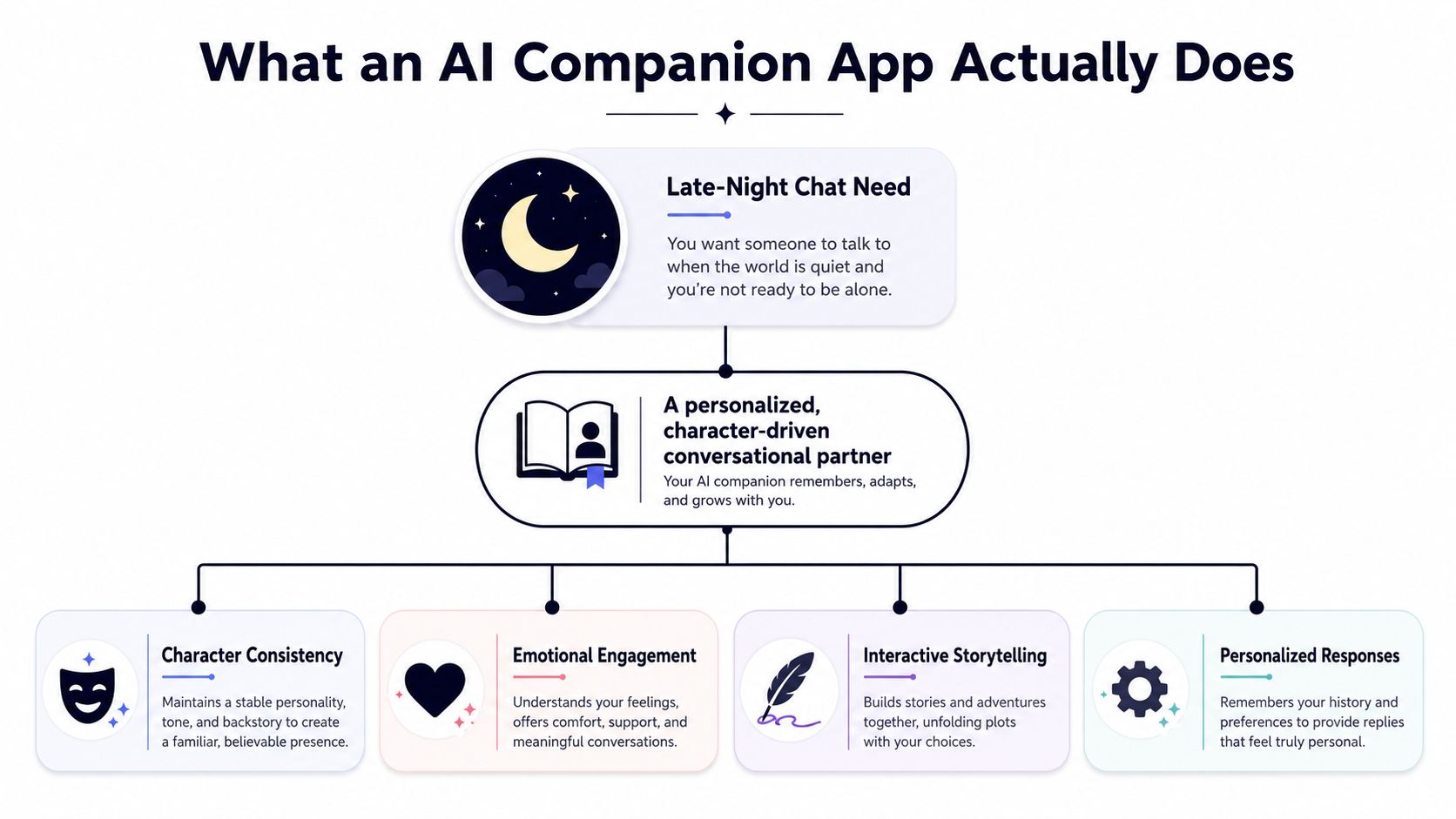
A general assistant is usually optimized to answer questions and complete tasks. A companion product starts with a distinct identity: a name, description or backstory, opening message, and a recognizable way of speaking. The conversation is the product, so continuity and character voice matter more than a long feature list.
Continuity does not mean perfect or lifelong memory. A useful companion should keep the current thread coherent and make its retention model understandable. If an app promises that it will always remember everything, look for a precise explanation before treating that as fact.
Voice, images, and creator tools can add depth, but none of them fixes a generic character. Start by reading the profile and opening message. Then send a concrete setup and see whether the character stays consistent after several turns.
How to Compare AI Companion Apps
Do not choose from a landing-page promise alone. Try the actual conversation and compare the parts that affect everyday use.
| Question | What to check |
|---|---|
| Does the character feel distinct? | Look for a clear identity, backstory, opening tone, and consistent replies. |
| How does continuity work? | Check whether later replies use the active thread and whether the app explains the limits of its memory. |
| What control do you have? | Look for response regeneration, character editing, and public or private creation options. |
| Which media modes are available? | Confirm whether voice and images are universal, character-specific, optional, or subject to limits. |
| Where can you use it? | Decide whether you want a browser experience, a native mobile app, or both. |
| Can you try it before registering? | Check whether guest access exists and what signing in adds. |
| Are content controls clear? | Look for visible audience settings, moderation rules, and age-appropriate boundaries. |
| What happens to your data? | Read the privacy and deletion terms instead of assuming that “private” means anonymous or encrypted. |
Price matters too, but compare the limits behind the price. A free entry point can still have generation limits, while a paid plan may reserve voice, images, or longer usage for certain tiers. Current product pages are more reliable than an old comparison chart.
How WSUP AI Works
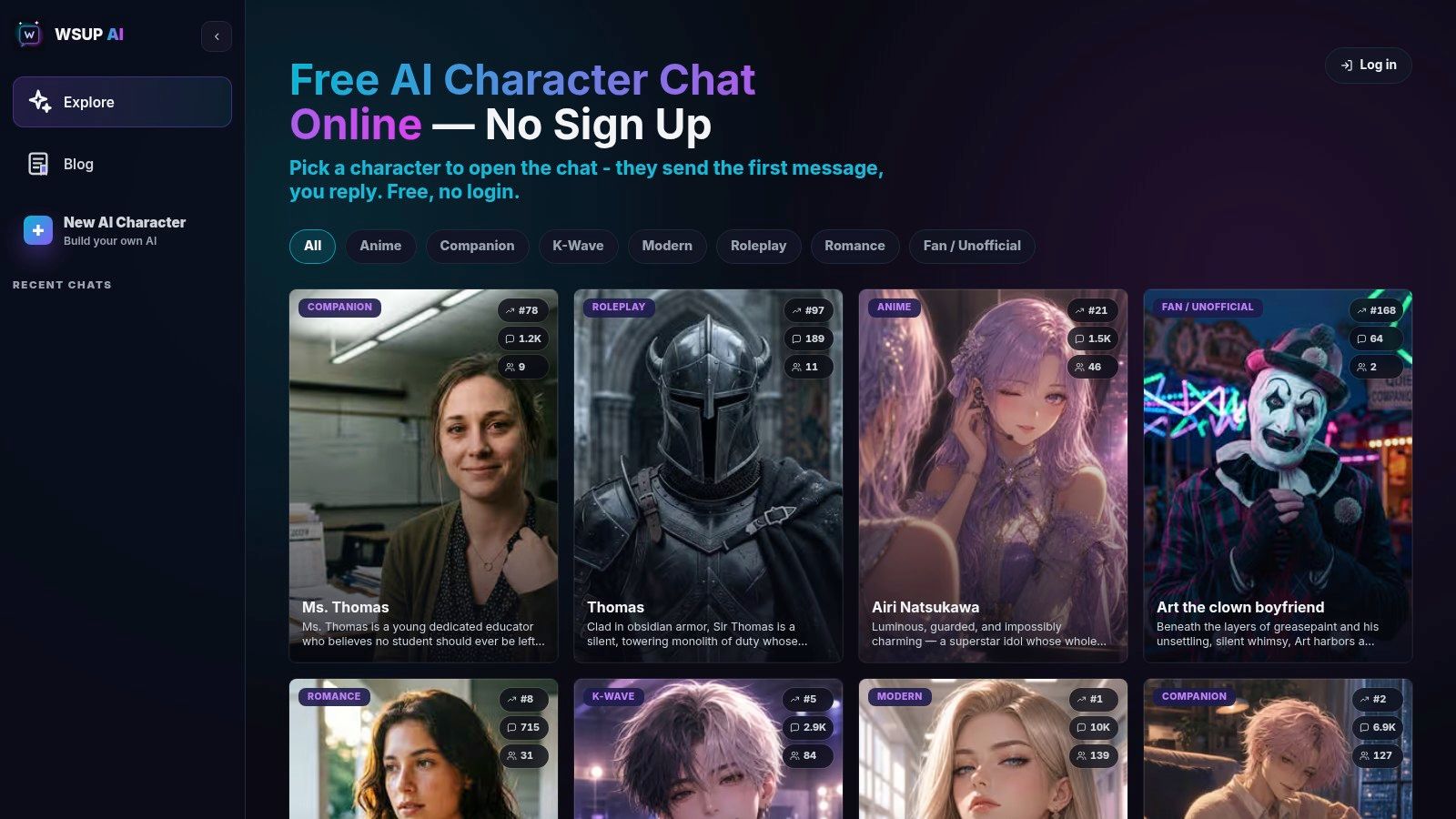
Start at the WSUP AI character roster and choose a public character. Each profile has an opening message, so you can judge the intended voice and scenario before committing to a long chat. You can begin as a guest; WSUP is a browser product, not a native iOS or Android app.
Once the conversation starts, WSUP maintains an active thread for that user-character chat and supplies prior messages from the thread to later replies. That supports in-thread continuity. It should not be described as perfect, permanent, or human-like memory.
If the tone misses, you can regenerate the welcome or the latest character response without starting the conversation again. This is especially useful when a reply breaks the scene or takes the character in the wrong direction.
Media is conditional rather than automatic. Audio is generated on demand only when an eligible reply shows an audio control. Image replies are optional: they are generated when you explicitly ask for a visual and the feature is available. The AI chat with voice guide explains the voice workflow in more detail.
What Signing In Changes
An account is optional when you begin. Signing in adds saved and synced chat history, lets you keep characters you create, and provides higher image and audio limits. Guest access lowers signup friction, but it is not a claim of complete anonymity or end-to-end encryption.
Create Your Own Companion Character
If the public roster does not match the persona you want, use Create Character. The creator supports a name, gender, category, description or backstory, opening greeting, portrait, and public or private visibility. It also offers filtered and mature-theme settings.
Private characters stay owner-only by default. Public characters require approval before they join the public roster. That distinction matters: “private character” describes visibility inside the product, not a blanket promise about data storage.
For a step-by-step approach to description, greeting, and personality choices, see how to create an AI character.
Which WSUP Companion Personas People Use
In the 30-day production window ending July 31, 2026, Spice, Kai, and Mika had the strongest reach among current Companion-category characters by unique regular visitors to their character pages. Configured test traffic and non-regular virtual traffic were excluded, and a read-only production conversation-volume check kept the same three at the front.
This is a dated usage ranking, not a quality score or a promise that the order will stay the same. Use it as a starting point, then read each profile and opening message. The right character is the one whose setup fits the conversation you want.
For more advice on starting and steering a scene, read how to talk to AI characters.
WSUP AI and Other Companion Apps
Replika, Kindroid, Nomi, and Character AI are often considered alongside WSUP AI, but they do not offer the same entry path or product emphasis. WSUP’s clearest distinction is practical: it is browser-first, lets you start as a guest, offers a browsable character roster, and includes a public/private character creator.
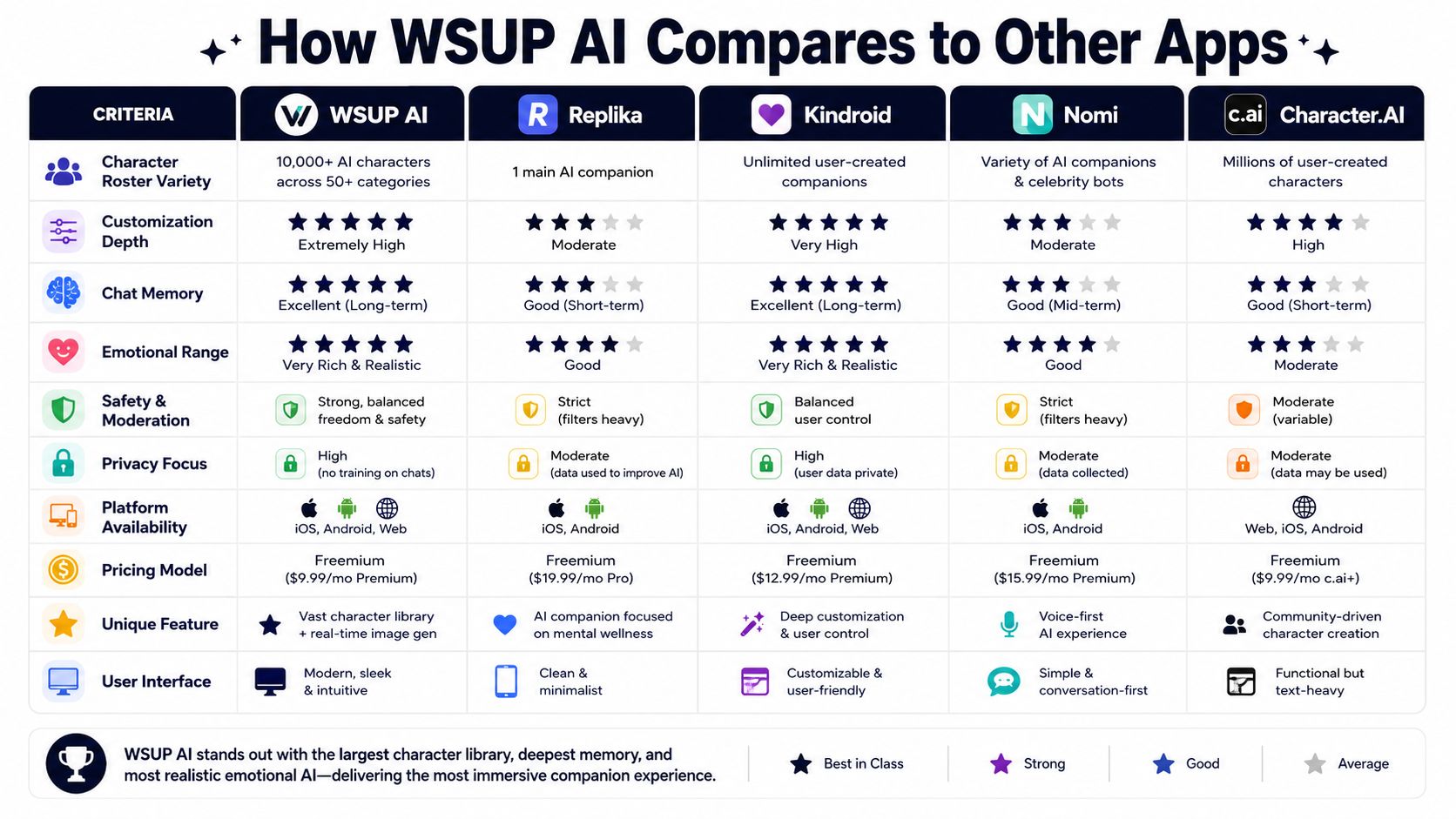
Choose by the experience you actually want:
Fast browser access: check whether you can start without an install or forced account creation.
One ongoing companion or a character catalog: decide whether you want to develop one persona or browse many.
Custom creation: compare private/public controls and how much of the identity you can edit.
Voice and images: verify current eligibility and limits instead of assuming every chat supports them.
Privacy and deletion: read the current policy for each service before sharing sensitive information.
Competitor platforms, prices, and policies change. Check their official product pages and app-store listings on the day you choose. For a broader character-platform comparison, use the Character AI alternatives guide.
The embedded third-party video offers another comparison of several well-known companion products. Treat any feature or pricing claim in it as a dated snapshot and verify it independently.
Privacy and Realistic Expectations
An AI companion can support roleplay, creative scenes, conversation practice, or casual company. It is still software, not a human relationship, therapist, or confidential professional service.
Before sharing anything sensitive, check where conversations are stored, whether they may be used to improve models, how account and data deletion work, and which content controls apply. Low-friction guest access is useful, but it does not by itself prove anonymity, encryption, or deletion.
For WSUP, read the current Privacy Policy and Terms. Apply the same standard to every alternative: prefer precise controls and current documentation over broad promises such as “completely private,” “unlimited,” or “always remembers.”
AI Companion App FAQ
Is WSUP AI free to try?
You can begin chatting as a guest. Usage and media features can have limits, so do not read guest access as a promise of unlimited generation.
Can I use WSUP AI without signing up?
Yes, you can start as a guest. Signing in adds saved and synced chat history, keeps created characters, and provides higher image and audio limits.
Does WSUP AI remember conversations?
It uses prior messages from the active character thread in later replies. That provides in-thread continuity, not perfect lifelong memory.
Does it support voice and images?
Yes, conditionally. Audio appears on eligible replies, while image generation is triggered by an explicit visual request when the feature is available.
Can I make a private character?
Yes. Private characters stay owner-only by default; public characters require approval.
Is there a native WSUP AI app?
WSUP AI is browser-first. Use it at the WSUP AI website without downloading a native app.
If you want to test an AI companion app without installing anything, choose a character on WSUP AI and start as a guest. Judge the product by the conversation itself: character voice, continuity, control, and clear limits matter more than a dramatic promise.