Best Character AI Alternatives for 2026
Find Character AI alternatives! Compare 10 top apps like WSUP AI & JanitorAI for roleplay, voice, media, privacy, & free access.
In July 2026, WSUP AI had 1,299 active chatters sending 90,750 messages, and 24.0% of them used reply regeneration. Those numbers are why it leads this list for browser-first, no-sign-up character chat with richer media controls. If you want character ai alternatives that do more than plain text, WSUP AI is the cleanest first stop. If your priority is community role-play or one persistent companion, Janitor AI or Replika will fit you better, and this guide says when.
Table of Contents
Why People Search for Character AI Alternatives
People leave Character.AI for one of four reasons. They want more control over replies, richer media like voice or images, different moderation settings, or a way to talk to AI online without signing up.
That is a bigger shift than a feature preference. Character.AI launched in 2022, and a 2026 overview puts its funding at about $180 million from investors including Andreessen Horowitz, SV Angel, and Lightspeed Venture Partners, which tells you how fast character chat went from novelty to serious consumer market (Voiceflow overview of Character.AI alternatives). The same overview says people use it for entertainment, creative writing, and language practice, so alternatives now compete on roleplay depth, memory, and customization rather than generic chatbot quality.
Users have become pickier, too. Semrush lists talkie-ai.com among the closest competitors to character.ai with 5.09 million visits, an authority score of 55, and a 34.94% bounce rate (Semrush competitor data). At that scale the market is a performance race over continuity, session length, and retention, which is why AI character chat buyers compare very specific product traits.
So the question is no longer "what's the best chatbot?" It is "which platform matches how much control, privacy, and media richness I want?"
How These Alternatives Were Evaluated
The only fair way to compare sites like Character.AI is to hold every product to the same criteria. Current comparison coverage keeps coming back to memory persistence, context handling, voice support, channel coverage, persona branching, compliance controls, guest access, reply regeneration, image replies, and character-level memory, so those are the traits that decide real purchases (YourGPT comparison guide).
People also split on moderation. Some want fewer filters. Others want a stable, low-friction companion. That split matters because the best platform for unrestricted roleplay is rarely the best platform for emotional support or a daily check-in (Techpoint's moderation-focused guide).
Privacy and setup cost weigh just as much. A browser platform that works the moment you land feels nothing like a tool that expects self-hosting, API setup, or other technical steps. Guides focused on privacy, memory, and no-code access keep pointing at that tradeoff, and they are right to, because "free" can still hide setup friction (Gempages guide on Character.AI alternatives).
Practical rule: if continuity is what you care about, compare memory and reply control first. If casual access is what you care about, compare signup friction and guest chat first.
Best Character AI Alternatives in 2026
WSUP AI
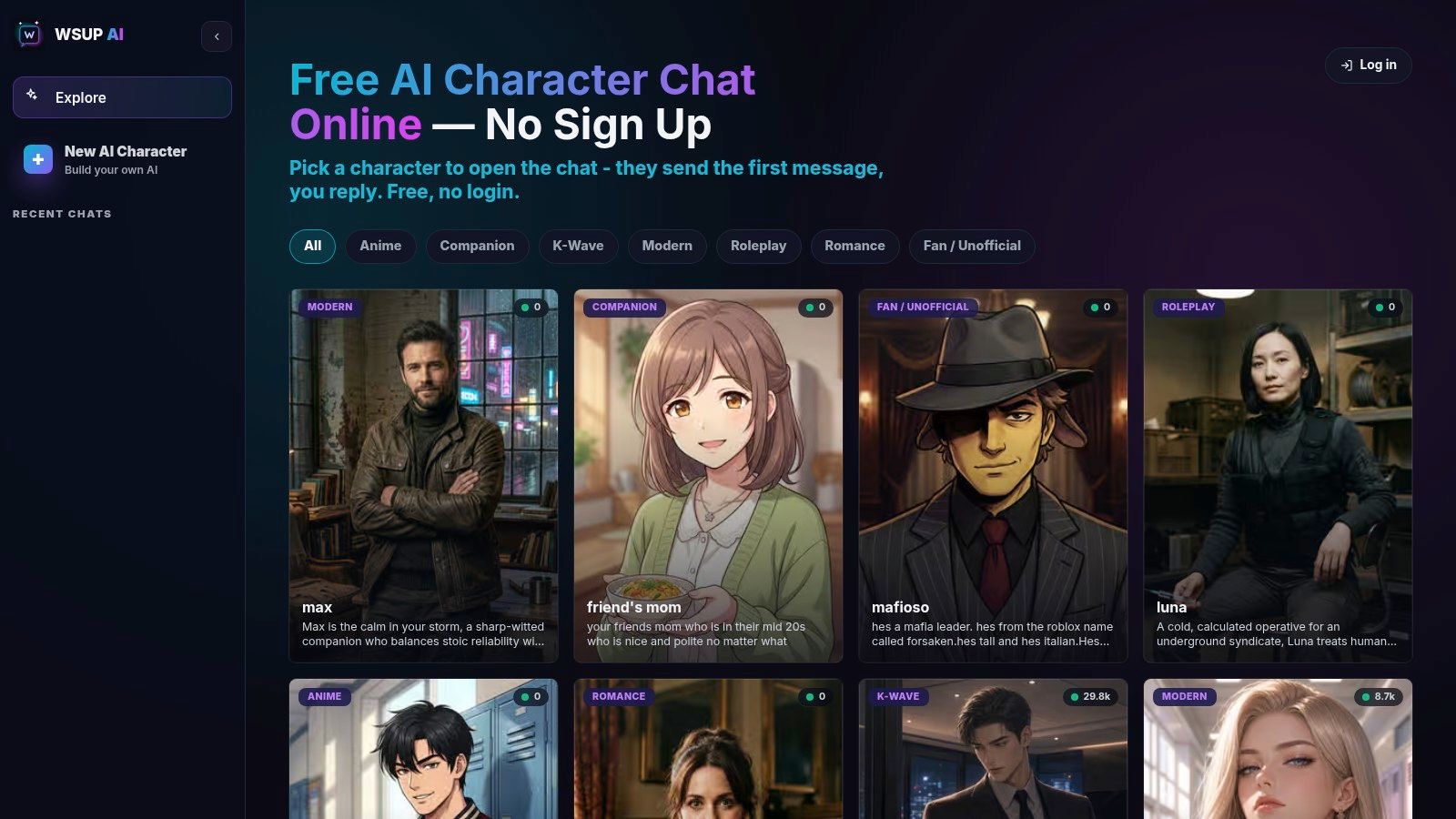
WSUP AI is for readers who want free AI character chat online with no sign-up for the first chat and more than plain text. Characters send the first message, so you start with a prompt and a tone instead of an empty box. For roleplay, fandom chat, and casual talk to AI use, that gets the conversation moving right away.
Everything lives in one chat flow, so the controls stay next to the conversation: context-aware personalities and backstories, reply regeneration, on-demand character audio, generated image replies, selected-character video previews, and AI-assisted public or private character creation. In practice you can fix an off-tone reply, hear a character's voice, ask for a visual, and build a new persona without leaving the chat.
WSUP AI's own engagement snapshot from July 12 to 25, 2026 shows those controls get used, not just listed. Across 1,299 active chatters, users sent 90,750 messages, received 90,446 replies, and 24.0% used reply regeneration. 19.2% started character audio, and 15.3% came back to chat on at least two different days (WSUP AI PostHog engagement data, July 12 to 25, 2026). Those are adoption signals, not proof of superiority over competitors. They do show that people reach for the media and control features once they have them.
The main tradeoff is continuity. Guest chats are not saved, so anyone who wants long-term memory needs an account. And because the platform is user-generated, character quality varies by persona, which is normal for the category.
For readers comparing character ai alternatives by interaction depth, WSUP AI stands out on three practical counts: no-signup entry, richer media, and reply control. The companion-character path suits people who want a guided conversation rather than a blank catalog search, as the WSUP AI companion character page shows.
If you want the fastest path into AI chatting online with image, voice, and reply control built in, start here.
Create character: WSUP AI create character flow
Janitor AI
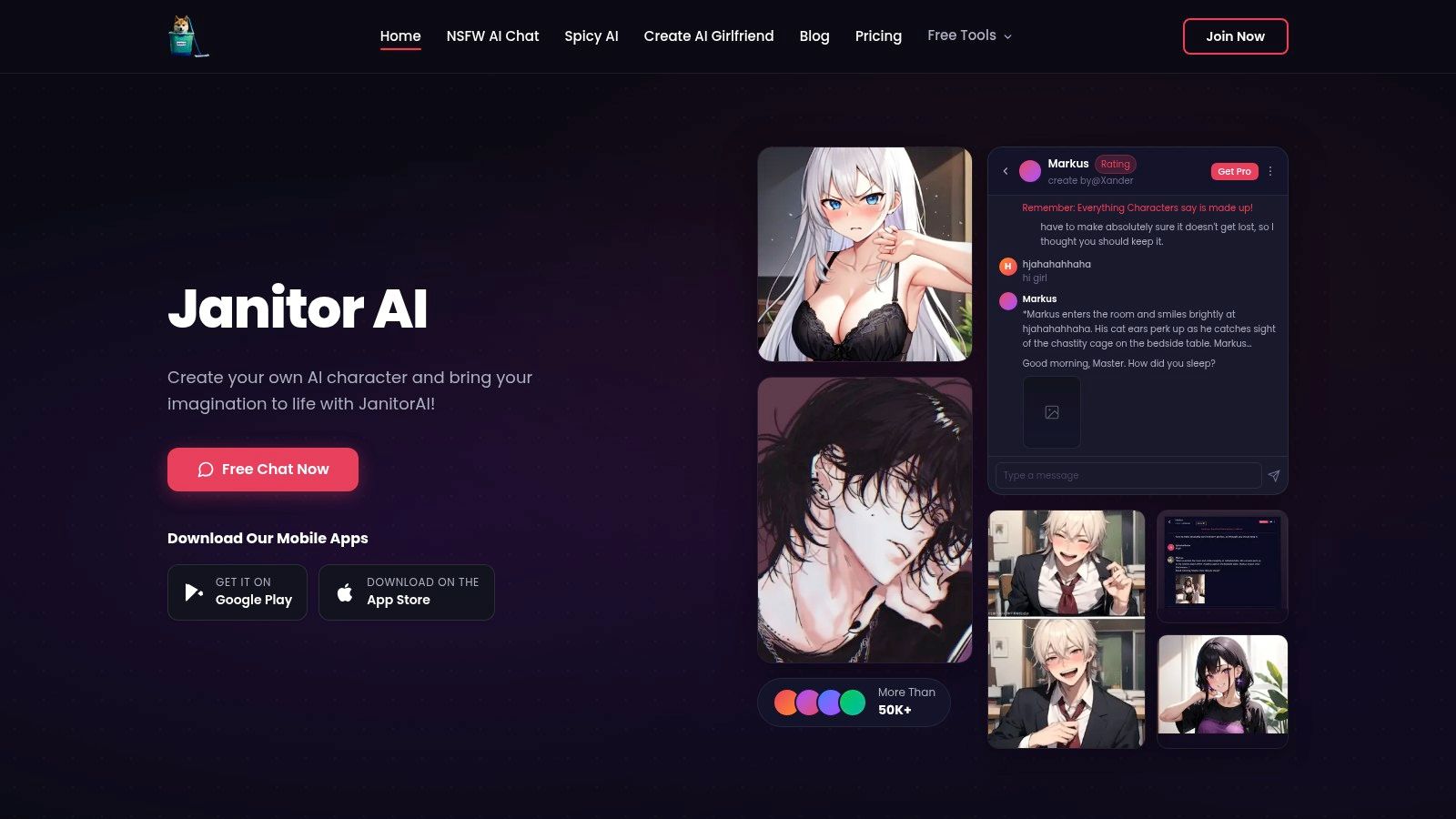
Janitor AI is for people who want a big, creator-driven character catalog and a more open role-play environment than the mainstream apps allow. It is built on user-made personas, so the draw is breadth and flexibility, not polished curation.
The whole structure leans into customization. Its in-house Janitor LLM plus support for external models appeals to people who like to experiment, and the memory and branching chat histories help role-play fans keep long scenarios organized. It runs on the web and has an Android app, so you can move to mobile without losing the browser.
Among character ai alternatives, Janitor AI is usually the better fit when community variety is your top priority. If you want to browse a big public directory and sample many styles of fan-created personas, it has a stronger "discovery" feel than any companion app. The downside is the one every community platform shares: quality varies a lot, and users report occasional bugs around updates.
Use it if you want flexible AI chats and a broad role-play library. Skip it if your main goal is a consistent companion or a polished no-signup flow.
Website: Janitor AI
Role-play tag page on WSUP AI: WSUP AI roleplay characters
Replika
Replika is the most openly companion-oriented option here. It is built for one-to-one conversation, relationship-style exchanges, and daily check-ins, so it fits people who want a persistent AI friend more than a roster of characters.
The core draw is continuity. Replika's memory-based design and relationship modes support a stable long-term companion, and its web plus mobile presence makes it easy to keep going across devices. Voice messages and calls sit in the higher tier, along with selfie and video features, so it also answers the "AI chat with voice" search.
The tradeoff is moderation and monetization. Replika is stricter than dedicated role-play platforms, and some of its best features live behind Pro. That makes it a better fit for people who value stability, routine, and emotional tone over open-ended experimentation.
For buyers comparing sites like Character.AI, Replika is less about spectacle and more about persistence. If you want a dependable conversation partner with one long-running thread of personality, it deserves a close look. If you want a broad character library or more permissive role-play, it will frustrate you.
Website: Replika
Companion tag page on WSUP AI: WSUP AI companion characters
Chai
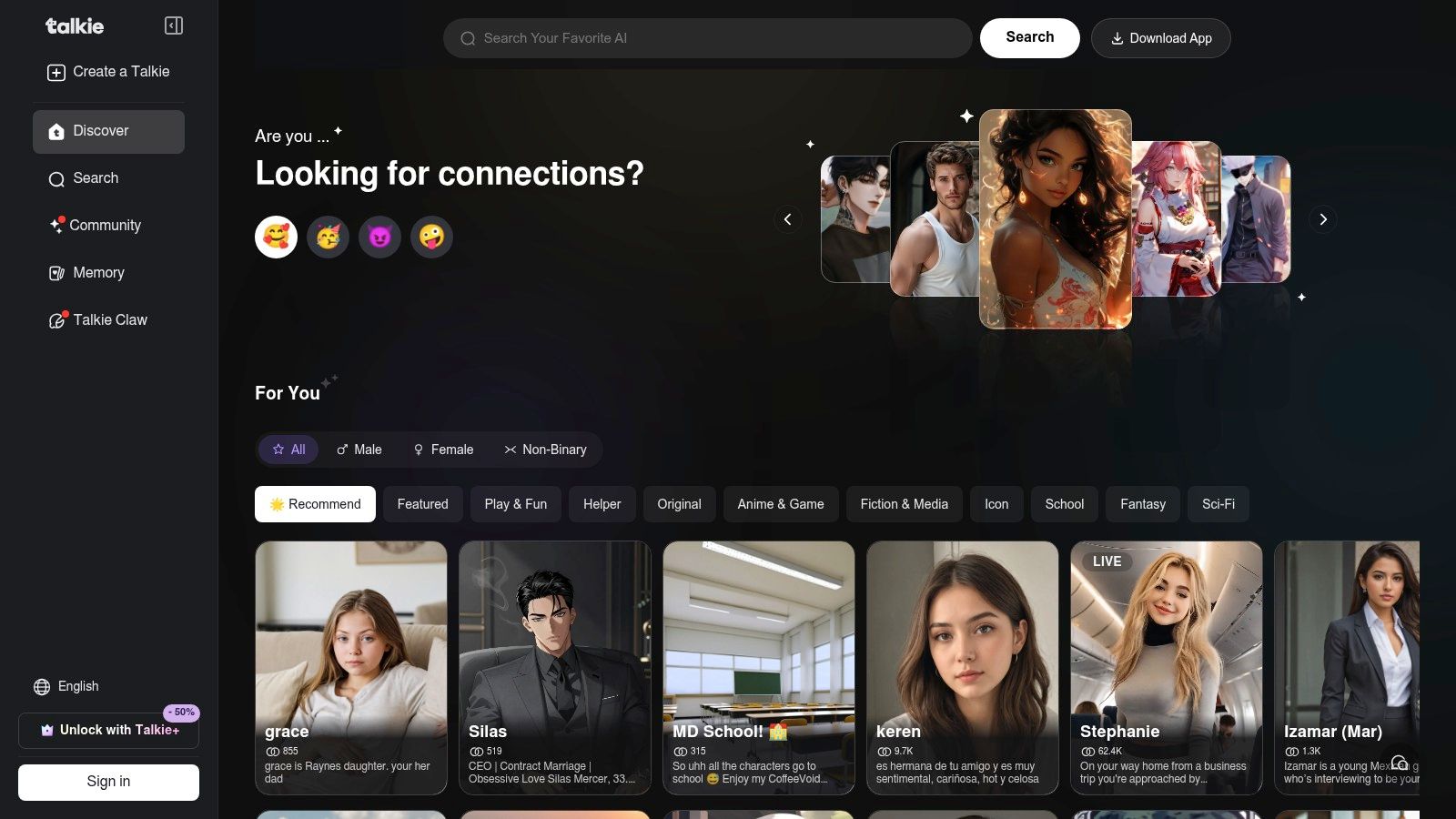
Chai is the mobile-first pick for people who care more about easy discovery than fine-tuned control. Its appeal is a big library of user-created bots and a simple browse-and-chat experience that works when you just want to start talking.
Its strength is accessibility. It is easy to get going on a phone, and its broader content posture has historically drawn people who want a wider range of role-play styles than stricter apps allow. That makes it a frequent stop for people searching for apps like Character.AI on iOS or Android.
Its main weakness follows most community-driven platforms. Free usage is capped by message counts that reset over time, and character quality depends heavily on who made the bot. Web access is not its main identity either, so browser-first users may feel boxed in.
Chai works best when you want a quick mobile habit and a big field of characters to sample. It works less well when you need strong continuity, media-rich replies, or a polished guest experience.
Website: Chai
Kindroid
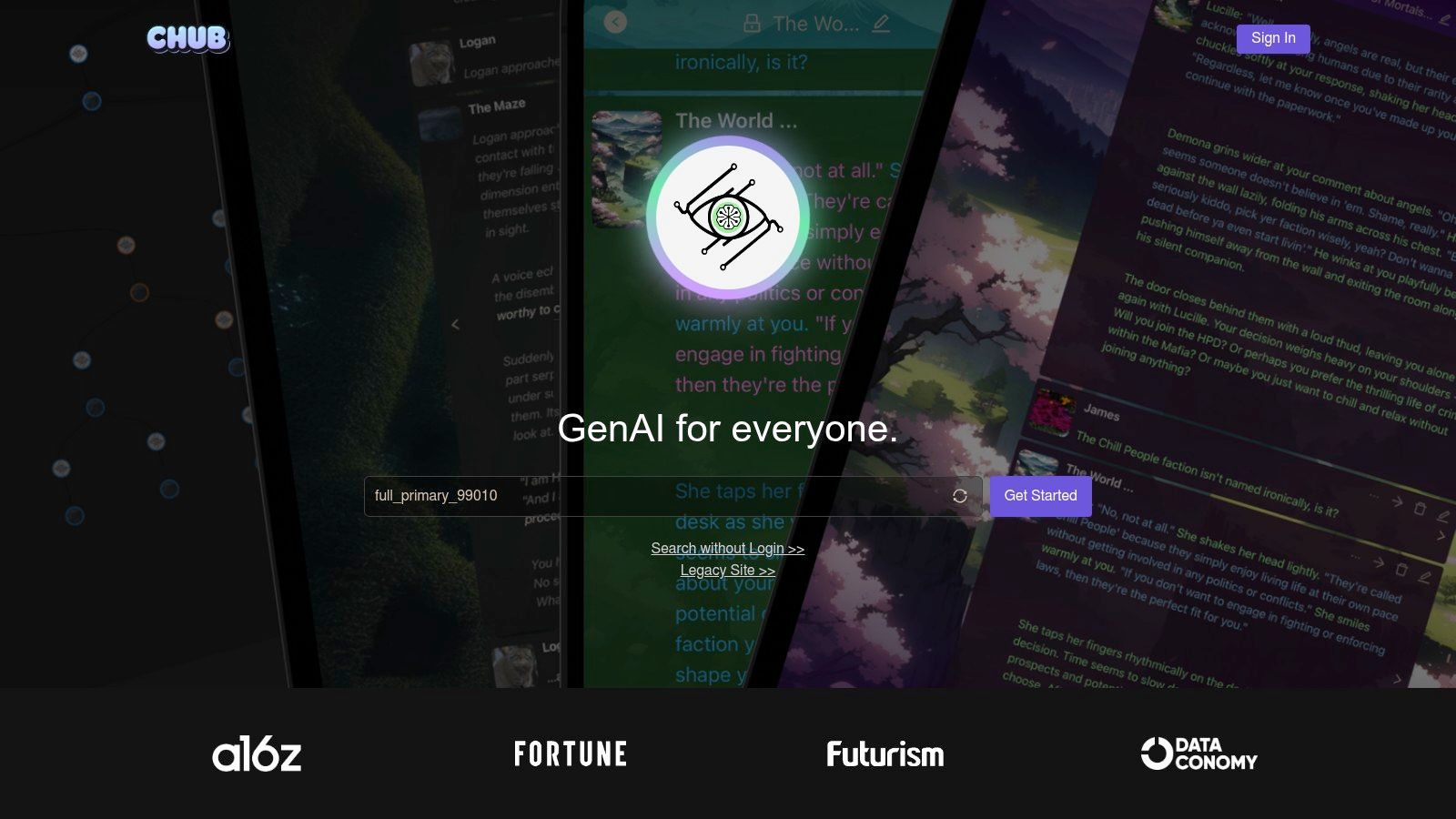
Kindroid is the strongest choice for building a single, evolving AI companion with deep continuity. It is about one persistent relationship rather than hopping between characters, and that focus shows in how it handles memory and personality setup.
The platform hands you a lot of control. You can shape backstory and key memories, which gives the companion more structure than a generic chatbot. It also includes voice messages and AI-generated selfies, covering the media layer many people now expect from AI character chat.
That makes Kindroid appealing if you want one consistent, personalized presence across web and mobile. It is less appealing if you want fast casual browsing or a large public character catalog. Its free tier is also limited enough that serious users run into subscription pressure quickly.
Kindroid sits between role-play platforms and companion apps. If you want continuity and customization more than breadth, it is a strong option. If your main goal is a free, no-signup first chat, WSUP AI is the cleaner entry point.
Website: Kindroid
Nomi
Nomi is another memory-centric companion app, with one feature that sets it apart: group chat. If you want several AI personalities sharing context inside one thread, that is rare, and Nomi has it.
Its design favors continuity. Short- and long-term memory persistence, voice messaging in both directions, and the ability to share photos or read links inside chats give it a more persistent, information-aware feel than lightweight character apps. For people looking at talk to AI tools as ongoing companions, that difference is real.
The tradeoff is content policy and pricing. Nomi is stricter than role-play platforms that cater to looser styles, and its better value appears to sit in annual plans rather than monthly flexibility. It is more of a commitment than a casual experiment.
If you value relationship depth, group interaction, and a fairly polished companion experience, Nomi earns a look. If you want open role-play or easy guest access, it is not the flexible choice.
Website: Nomi
Talkie Soulful AI

Talkie is for people who want a browser-friendly start and built-in voice without much setup. It leans into character discovery and a shareable gallery, so it feels more like browsing scenes and personas than configuring a system.
Its strongest point is accessibility. Web chat without login makes it attractive if you want to try AI chat free before committing to an account, and the Creation Center lets you build custom personas without a steep learning curve. Its public character library and content hubs make exploring easy.
The tradeoff is consistency. App-store availability has been uneven at times, and moderation can feel strict for some role-play styles. Talkie is at its best for a quick start, voice interaction, and guided discovery, not for the loosest possible play space.
If you want a character-chat environment that feels polished and easy to browse, Talkie is worth a try. If your priority is total control or a stronger no-signup browser flow, WSUP AI is more direct.
Website: Talkie Soulful AI
Poly.AI PolyBuzz
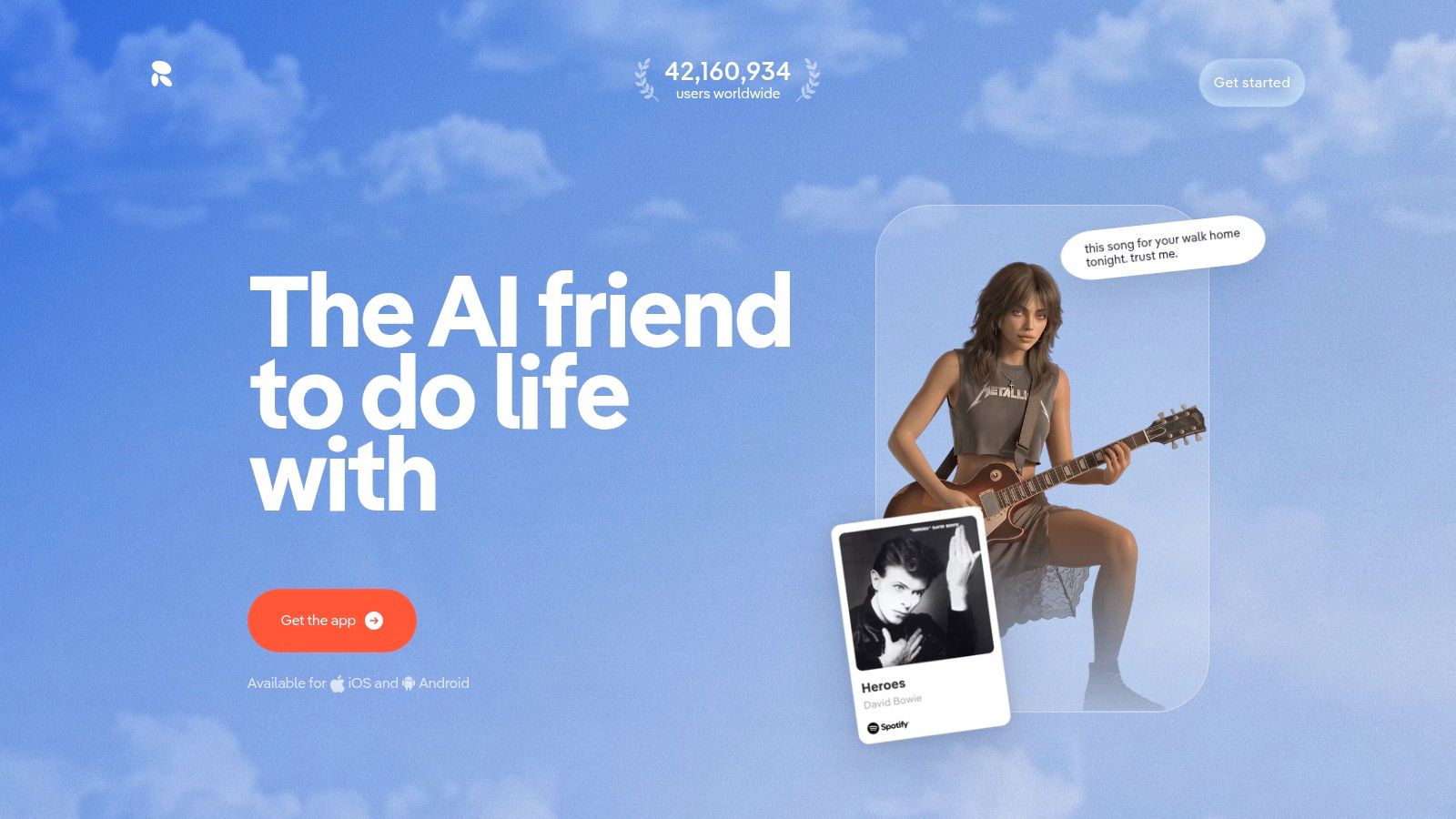
Poly.AI, called PolyBuzz in some comparison coverage, is built for variety. It has a large searchable character library, web access, and in-chat image generation, so it naturally appeals to people who want a browser platform with a visual layer.
The product is broad rather than deep. You can explore realistic personas, anime characters, fantasy figures, and other community-built options, which is useful when you are sampling different kinds of role-play. Because it is browser-based, it also suits casual users who do not want another app installed.
Its weakness is the standard one for open character libraries. Quality varies because user-generated content is uneven, and some people find the interface cluttered next to more focused apps. Even so, for discovery plus visual replies it is a credible option in the character ai alternative space.
PolyBuzz works best when you want lots of characters and a browser-friendly path into visual chat. It is less compelling if you want a tightly controlled companion or a very clean interface.
Website: Poly.AI
CrushOnAI

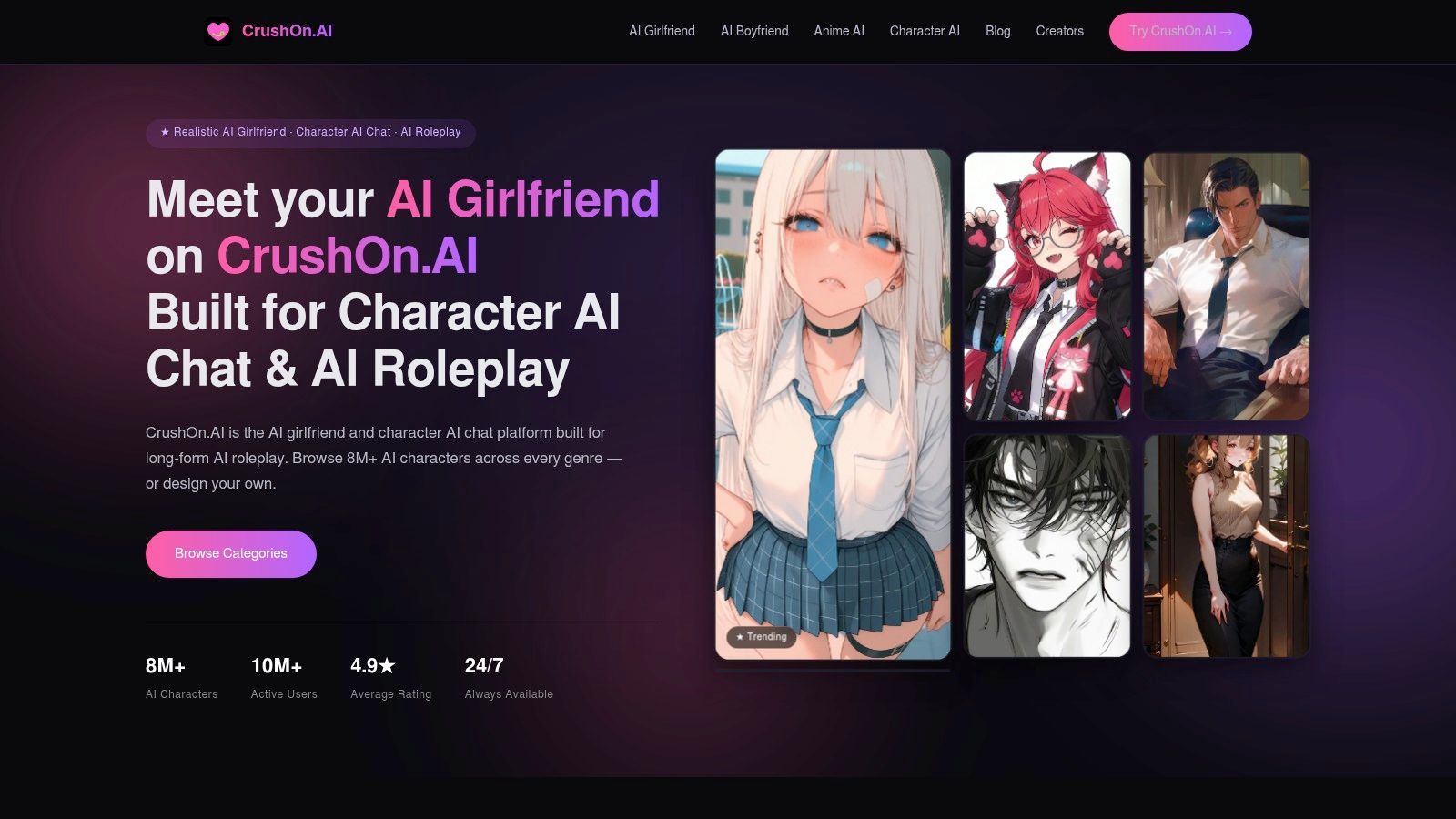
CrushOnAI is for people who prioritize minimal filtering and a large library of community-created characters. It shows up in searches for NSFW-friendly role-play, and that positioning is the main reason people consider it.
The appeal is speed and permissiveness. Its web app has a quick-start flow and supports image generation inside chats, which gives scenario RP more texture than plain text. That suits people who want fast browser access with fewer guardrails.
The tradeoff is cost and variability. The free tier is limited, heavy use gets expensive, and quality depends on whoever built the character. Those are normal constraints for open character creation, and they matter if you are weighing it against more polished companions or no-signup browser experiences.
CrushOnAI makes sense if you already know you want more open role-play than the mainstream apps allow. It is not the choice for casual family-safe use or for the smoothest free access.
Website: CrushOnAI
Anima MyAnima.ai
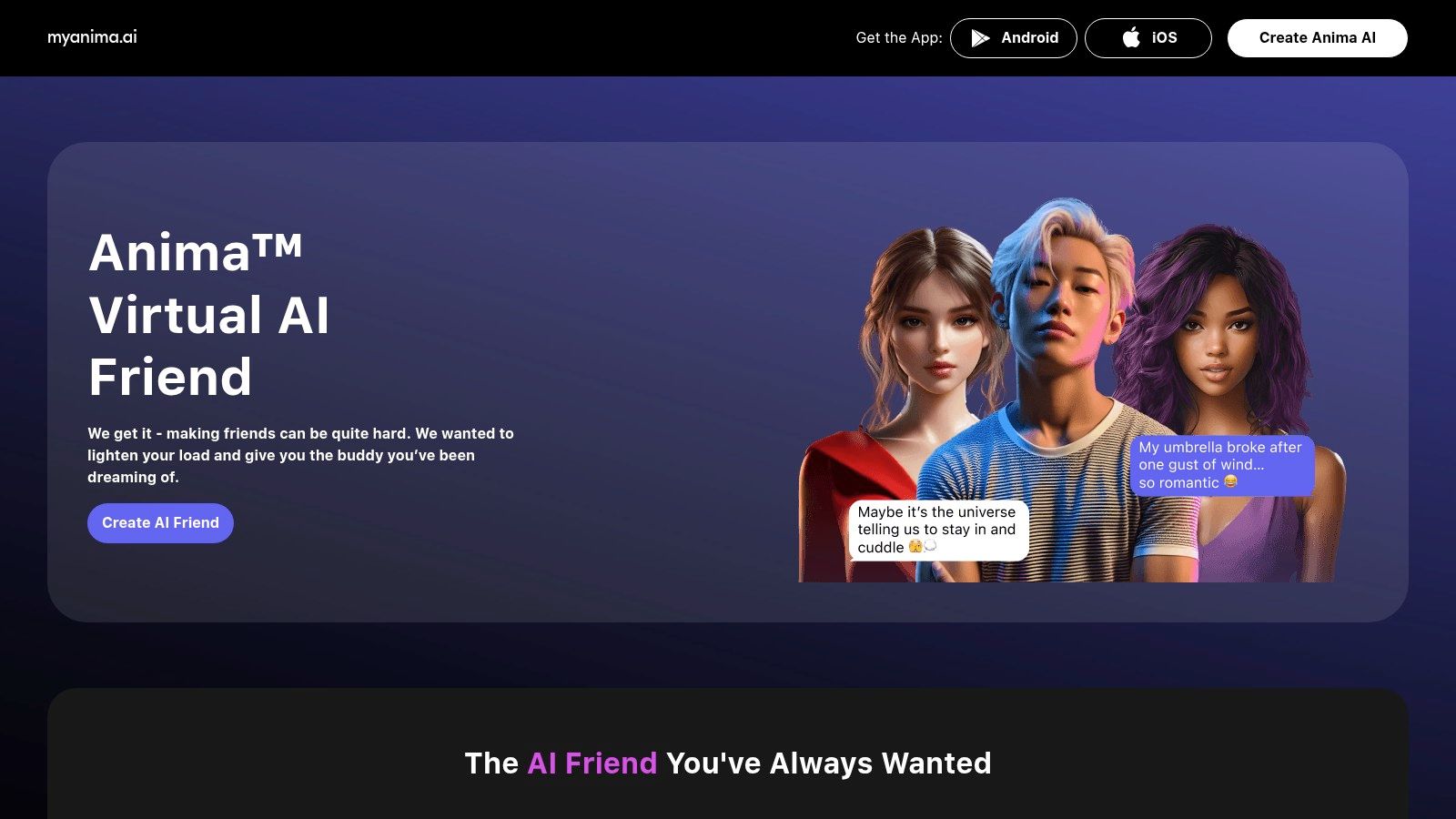
Anima is a straightforward AI companion app for people who want a customizable friend rather than a deep role-play sandbox. It supports personality traits, voice and image features, and web plus mobile access, so getting started is simple.
Its strength is approachability. New users can shape an AI friend without much setup, and the flexible conversation style works for light RP or casual companionship. That makes it a decent on-ramp for people new to AI chats.
The limitation is depth. Next to power-user role-play platforms, Anima gives you less granular control, and many of the advanced features are tied to premium. It is easier to start with than to customize.
If you want an easy companion app with broad availability, Anima is a reasonable option. If you want a browser-first character experience with reply regeneration and richer media in the first session, WSUP AI is the more direct fit.
Website: Anima
Top 10 Character AI Alternatives Comparison
| Product | Key features | UX / Quality | Unique selling point | Target audience | Pricing & limits |
|---|---|---|---|---|---|
| WSUP AI, Free AI Character Chat Online | Browser-first chats, opening messages, regen replies, voice, images, motion portraits, create/edit characters | Instant start (no signup), context-aware models, median session 15.6 min, regen/audio adoption metrics | Home page as product, immediate multimodal character experience with distinct personalities | Roleplay, interactive stories, fandom, casual companionship | Free guest chats; optional account saves history and raises image/audio limits |
| Janitor AI | Large public directory, in-house LLM + external model support, memory & branching histories, web & Android | Vast variety, community-driven, occasional stability issues | Flexible model support and looser content policy for freer RP | Freeform roleplayers wanting variety and fewer filters | Free; community content varies (some paid features possible) |
| Replika | Memory-based 1:1 companion, relationship modes, voice messages/calls, mobile & web | Stable, predictable companion experience, strong long-term personalization | Focused on emotional support and consistent daily companionship | Users seeking emotional support, routine check-ins, deep personalization | Freemium; Pro subscription unlocks voice calls and advanced modes |
| Chai | Mobile-first, large library of user-created bots, simple discovery & chat | Easy mobile UX, quick discovery, inconsistent character quality, message caps | Mobile discovery and fast access to diverse community bots | Mobile explorers who want many character options | Free tier with message limits; paid tiers for more usage |
| Kindroid | Strong long-term memory, backstory customization, voice messages, AI selfies, cross-platform | Excellent continuity and user control, deep narrative capability | High user control over backstory and evolving personality | Users building one deep, evolving companion relationship | Free tier limited; subscription encouraged for heavy use |
| Nomi | Short & long-term memory, voice messaging, group chats, photo sharing | Strong conversational continuity, relationship-focused design | Group chats with multiple AI companions sharing context | Users wanting multiple consistent companions and group interactions | Transparent in-app pricing; best value on annual plans |
| Talkie: Soulful AI | Web chat w/out login, built-in voice, creation center, public library | Instant browser access, voice-forward UX, app store availability varies | Voice-first character chats and shareable gallery | Users wanting quick voice chats and easy persona creation | Free web access; mobile app availability can vary |
| Poly.AI (PolyBuzz) | Large searchable character library, in-chat image generation, web-based, creator tools | Wide exploration options, visual generation; UI can feel cluttered | Searchable exploration plus image gen inside chats | Exploratory roleplayers seeking varied genres and visuals | Free web access; user-generated content quality varies |
| CrushOn.AI | Large scenario RP library, in-chat image generation, creator profiles, quick-start web app | Fast browser start, minimal filters, quality varies by creator | Minimal filtering, often NSFW-permitted roleplay | Users seeking fewer restrictions and NSFW-friendly RP | Free tier limited; paid tiers for heavy usage and features |
| Anima (MyAnima.ai) | Create/personalize AI friend, adjustable traits, voice & image, web & mobile | Simple setup, approachable UX, decent customization | Easy personalization with anime-themed modes | Newcomers wanting a friendly, customizable AI buddy | Freemium; many advanced customization features require premium |
Which Alternative Fits Which Use Case
If you want the best all-around browser-first start, choose WSUP AI. It combines no-signup access, reply regeneration, character audio, image replies, and motion previews in a way built for people who want to talk to AI immediately rather than set up a system.
If you want a large community character library and looser role-play, Janitor AI is the stronger fit. It is closer to a creator marketplace for personas. WSUP AI is stronger when you want a polished, media-rich conversation to start right away.
If you want a persistent companion instead of a role-play playground, Replika, Kindroid, and Nomi make more sense. Replika is the most relationship-oriented, Kindroid gives you the most direct control over personality and memory, and Nomi adds group chat and link-aware conversation.
If you want a girlfriend-platform comparison that covers Replika, Nomi, and Kindroid plus dedicated apps such as DreamGF and Candy AI, including free-plan and pricing details, see The AI Landscape's Top 5 AI Girlfriend Platforms roundup.
If you want mobile-first discovery, Chai is easier to browse on a phone. If you want voice-heavy character chat, Talkie and Replika both deserve attention. If you want a more open scenario style with image generation, PolyBuzz and CrushOnAI are more relevant.
Stop asking which app is "best" in the abstract. Ask whether you want guest access, role-play freedom, emotional continuity, or media-rich control. Those are different product categories wearing similar labels.
How to Choose Without Wasting Time
Start with the friction that annoys you most. If a sign-up wall keeps you from trying the product, go to WSUP AI, Talkie, or any platform with clear browser access and no hard gate. If the problem is a flat reply that goes nowhere, go to tools with reply regeneration and stronger continuity controls.
Then decide how much moderation you want. A looser platform is useful for open-ended role-play, and it also brings more noise and inconsistency. A stricter companion app feels less flexible, and it often gives you a steadier conversation rhythm.
Finally, keep media and memory separate in your head. Voice, images, and motion previews make chats feel alive. They do not replace a coherent backstory and conversation context. The best character ai alternatives now win by doing both.
Choose the least complicated tool that solves your main problem. Extra flexibility only helps if you will use it.
FAQ
What makes a good Character.AI alternative
A good alternative solves the exact reason you left. For some that means no-signup access. For others it means better memory, voice support, or more open role-play moderation.
Is there a free AI chat option without signing up
Yes. WSUP AI supports a first chat in the browser without sign-up, and some other platforms lean toward guest or quick-start access too. The real question is whether you also want your history saved after that first session.
Which platform is best for role-play versus companionship
Janitor AI and CrushOnAI are stronger for open role-play. Replika, Kindroid, and Nomi are better when you want a persistent companion relationship rather than a broad character library.
Which Character AI alternative has the richest media features
WSUP AI is the most balanced option here because it combines reply regeneration, audio, generated images, and video previews in one browser-first flow. Some competitors offer voice or image features. Fewer combine them as directly in the first chat.
Which app is best if I only want to chat casually on mobile
Chai and Replika are the most straightforward mobile-oriented options in this group. Chai is better for browsing many bots. Replika is better if you want one consistent companion.
For an iPhone-specific comparison of browser-based companions, see BestGirlfriend.ai's iPhone Safari guide. It includes affiliate links, so compare the current features, limits, pricing, and terms on each provider's own site.
Start Your Next AI Conversation
The right Character AI alternative depends on what frustrates you most about your current setup. If you want instant access, richer media, and more control over each reply, WSUP AI is the most practical place to start. If you want a community-driven role-play catalog or a companion app with deeper relationship continuity, Janitor AI and Replika cover those cases better than any one-size-fits-all ranking could.
The category has grown past simple chatbot comparisons. Buyers now weigh memory, moderation, voice, images, guest access, and setup friction, and that is the healthier way to choose because it matches how people use AI character chat. If you are still deciding, pick the one feature that matters most to you, then try the platform that delivers it with the least hassle.
WSUP AI is for readers who want to talk to AI in the browser, start a free AI chat right away, and use richer tools like reply regeneration, voice, and image replies without a signup wall. Try a character now at WSUP AI, and start with a persona that fits the kind of conversation you want to have.